
How we engineered a seamless on-chain insurance layer that protects depositors at withdrawal - no claims, no committees, no friction.
Product: Catalysis Cover; Domain - DeFi · Risk infra; Stack- ERC-4626 · Solidity
The problem
Over $100B in DeFi sits completely unprotected. Anyone depositing into a yield vault takes on a bundle of invisible risk: smart contract bugs, oracle failures, economic design flaws, and strategy losses - none of it priced, none of it disclosed at the point of deposit. When things go wrong, losses are simply absorbed by depositors.
$100B+ - Unprotected DeFi capital - a fraction carries any coverage
$400M+ - Lost to DeFi exploits in 2026 alone
0 Clicks to file a claim with Catalysis Cover
Previous DeFi insurance protocols compounded the problem: they used protocol tokens as collateral to insure the same stack those tokens lived in. When an exploit hit, collateral value collapsed exactly when payouts were needed most. Catalysis takes a different path entirely.
The solution
Insurance that wraps the vault, not the depositor
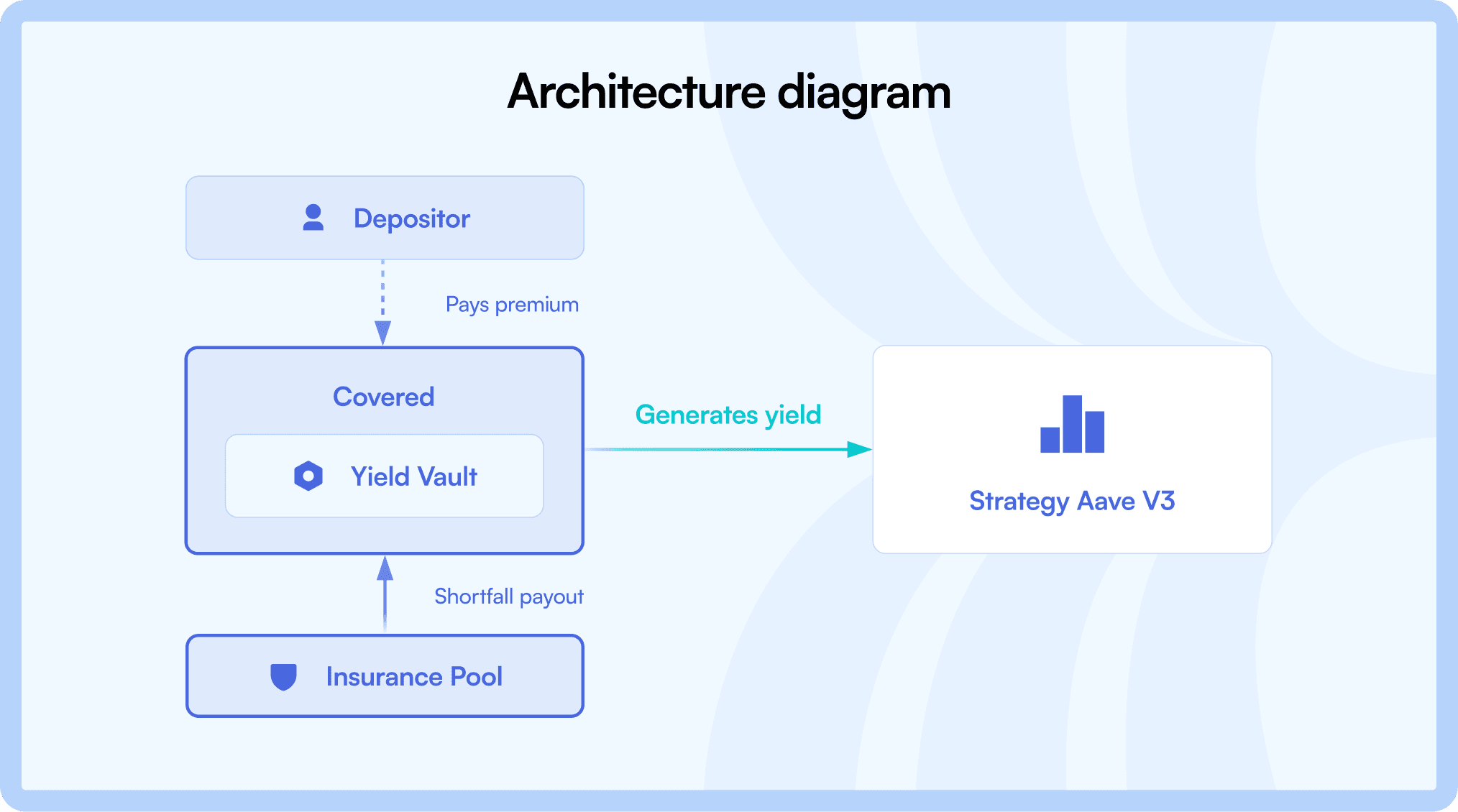
Catalysis Cover lets a curator take any existing yield-bearing vault and wrap it in a "covered" version that carries a live insurance policy. Depositors keep earning the same yield as before - but now their principal is protected against strategy losses up to a defined limit. No separate policy to purchase. No claim form to submit. The protection resolves automatically at the moment of withdrawal.
"The protection is delivered to each depositor individually at the moment they actually realize a loss - the vault's share price always reflects what the strategy is genuinely worth."
Coverage is funded by a premium the curator draws from vault fees, keeping the cost bounded and known in advance. The insurance accounting is handled entirely off the vault's NAV, so the reported share price stays clean and auditable at all times.
How it works
Four steps, one seamless experience
1 Deposit | 2 Earn |
|---|---|
User deposits into the covered vault. The protocol records their protected amount at entry. | Funds earn yield normally via the underlying strategy. The covered vault behaves identically to a standard ERC-4626 vault. |
3 Compare | 4 Settle |
At withdrawal, the protocol compares current position value against the original deposit amount. | If a shortfall exists within policy limits, the insurance pays the difference inline - in the same transaction as the withdrawal. |
If a shortfall exists within policy limits, the insurance pays the difference inline — in the same transaction as the withdrawal.
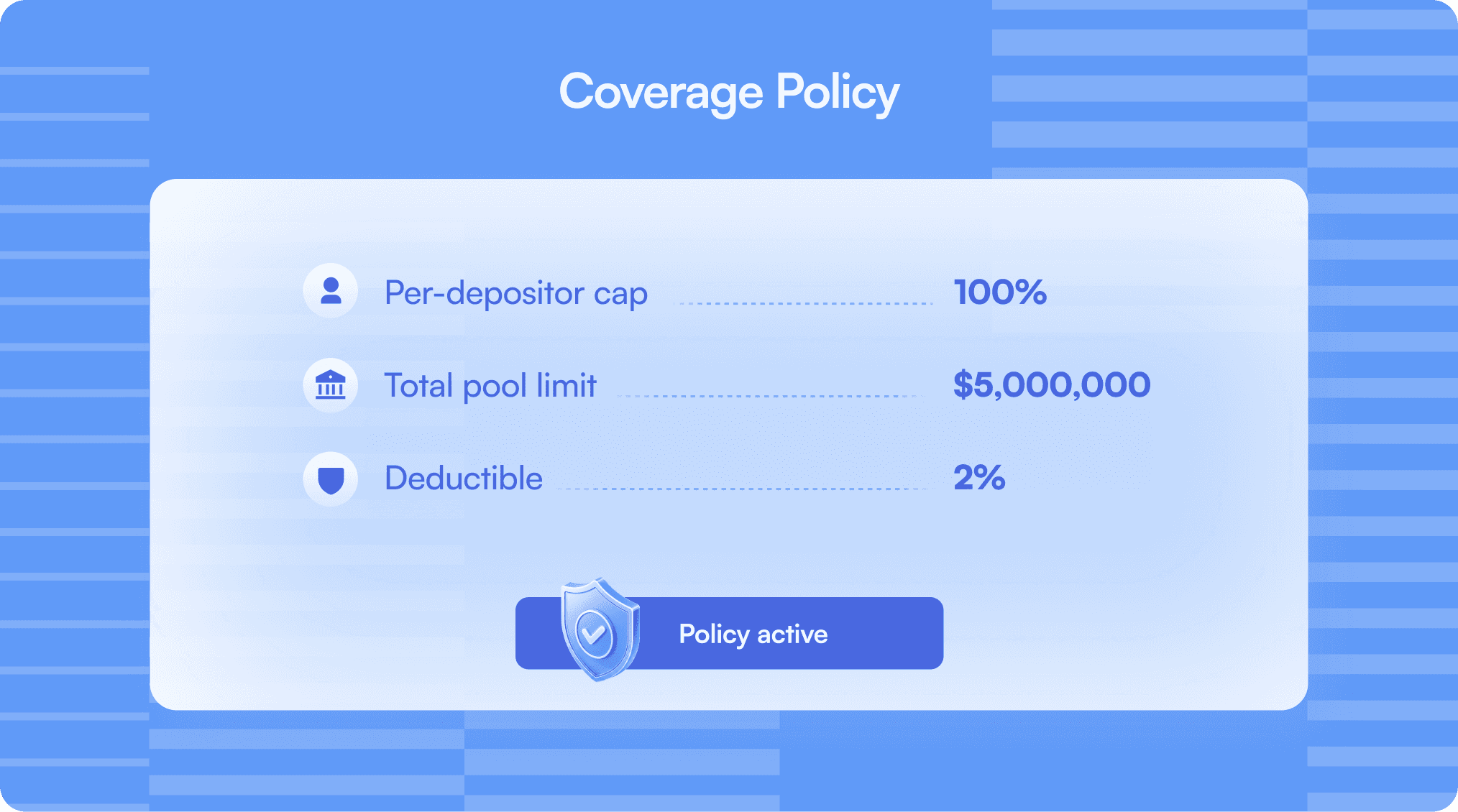
Policy parameters are defined upfront: a maximum percentage covered per depositor, a total vault-wide payout cap, and a small deductible absorbed by the depositor. Losses within those limits are reimbursed automatically; losses beyond them are shared proportionally as they would be in any ordinary vault. Once the policy expires, the covered vault reverts to standard behavior.
What we have built
A new primitive for risk-aware capital
Automatic claim settlement | Shortfalls are detected and paid in a single withdrawal transaction. No governance vote, no claims committee, no waiting period. |
|---|---|
Clean NAV accounting | Insurance flows are kept entirely separate from the vault's reported value. Share price always reflects the strategy - nothing else. |
Configurable policy parameters | Per-depositor coverage cap, total pool limit, and deductible are all set at policy creation - giving curators full cost predictability. |
ERC-4626 compatible | The covered vault is a standard ERC-4626 wrapper. Any protocol that integrates the underlying vault works with the covered version out of the box. Institutional-grade risk signaling |
Bounded, priced insurance transforms opaque technical risk into a transparent, quantified instrument - the bridge traditional finance needs to deploy into DeFi at scale.
Why it matters
Insurance as a native vault property
The DeFi insurance market has historically failed because coverage was bolt-on, manual, and reflexively correlated with the assets it was meant to protect. Catalysis Cover is different: the insurance is structural, automatic, and isolated from the vault's own performance.
For depositors, this means genuine principal protection - not a token-denominated promise, but a contractual, on-chain guarantee that resolves at the moment of need. For curators, it means a meaningful competitive differentiator: a vault that comes with protection built in commands more trust and attracts capital that would otherwise stay on the sidelines.
For the DeFi ecosystem at large, it fills a gap that has kept institutional and risk-conscious capital away. Robust on-chain insurance - bounded cost, no governance latency, clean accounting - is the primitive that lets a bank, a fund, or a cautious retail user say yes.
Ready to build primitives that move the market?
We don't do hand-holding, and we don't build in a vacuum.
You bring the vision - we ship S-Tier Web3 products that scale.
Contact @woof_software today!

Book a call with Pasha Bergman
Schedule a call with our CEO to receive practical recommendations and a prompt proposal for upgrading your solution.
Team behind this project