
Companies that commit to bulk AI inference upfront often get stuck with unused capacity when launches slip or models change, with no way to recover the cost. Woof Software's Savva Pryvalov explores a compute currency model where prepaid inference tokens on Cardano can be traded or resold, giving buyers a way out of sunk-cost commitments.
POV: your company runs an AI product, and because you expect to burn through a lot of inference, you commit upfront to get a better price.
Then the launch slips. Or you move to a different model, or customers end up using far less than your forecast said they would. None of that changes the invoice; you still paid for the original commitment. And somewhere else, another team is shopping for exactly the inference you're sitting on.
So why can't you sell them the part you won't use?

Your upfront API commitment shouldn't become a sunk cost.
That question is where the compute currency we're exploring at Woof Software starts: tokens that represent inference you can actually use, plus the ability to trade whatever you haven't consumed. For a buyer, the pitch fits in one line: commit upfront for better terms, and keep a way out.
How it would work
We'd negotiate a bulk purchase with a supplier, and that agreement would have to include permission to resell access. The supply we buy backs tokens issued on Cardano, where each token stands for a defined amount of inference with the model, usage rules and expiry spelled out.
Buyers get their own API keys, and every call they make draws down their balance, much like prepaid credits work today. The difference shows up when they want to sell. Whatever amount they list gets locked so they can't spend it while it's on the market, and once someone buys it, the new owner can use it and the seller can't.
In other words, when the token changes hands, the right to consume the inference goes with it.
What the money looks like
Take an illustrative deal. A package that would cost a buyer $10,000 directly, we negotiate down to $8,000 and sell for $9,000, which leaves the buyer $1,000 better off and gives us $1,000 before operating costs.
Treat those numbers as an example rather than a supplier quote. Whatever discount we actually get has to pay for the work and risk of running the service, and if it can't, the model doesn't hold up.
Resale is a separate story. If a buyer later sells unused tokens, the proceeds go to them minus our marketplace fee, and the price is whatever someone else will pay at that moment. An option to sell isn't a guaranteed refund; it's a chance to recover part of the cost, and sometimes that chance will be smaller than you'd hope.
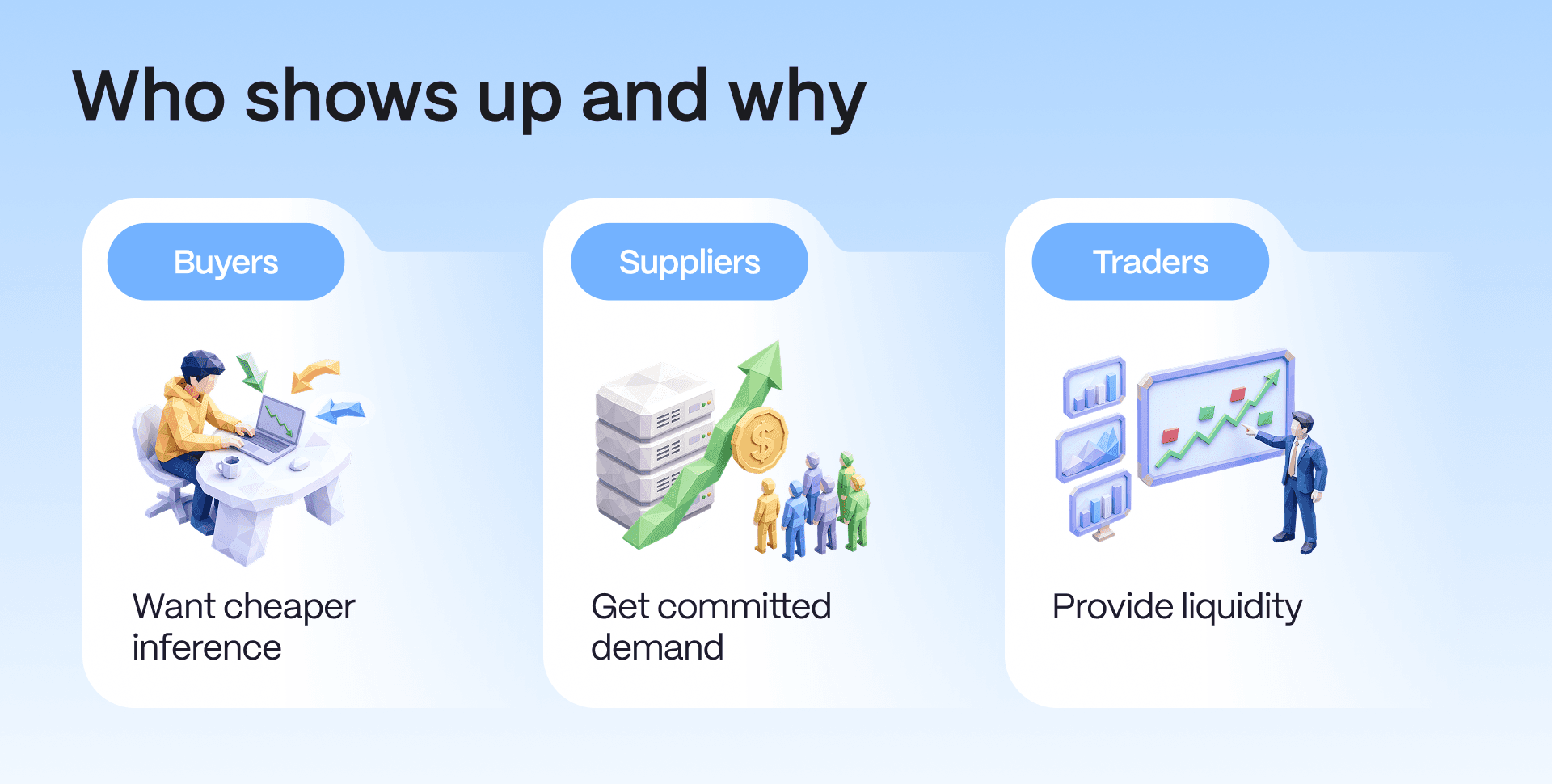
Functioning ecosystem for compute currency.
Three groups could take part, for different reasons:
Buyers, who want cheaper inference and room to adjust when plans change.
Suppliers, who get committed demand, cash upfront and customers they might not have reached on their own.
Traders, who'd buy tokens because they expect someone to value that access more later.
The traders are where the bigger ambition sits. A market where people can take positions on the price of usable inference doesn't really exist yet, and eventually borrowing and lending could let people go short too. But that needs liquidity, collateral rules and buyers on both sides, and issuing a token gets you none of those by itself.
What the chain does (and doesn't)
Cardano's job here is narrow: a shared record of who owns what, plus a way to swap tokens for payment. Our service connects that ownership record to actual inference access, while prompts, responses and API keys stay offchain.
The supplier comes first
None of this ships without a supplier agreement that explicitly allows it, because standard credits usually don't. OpenRouter's standard credits are nontransferable, for example, so a product like this needs its own arrangement, one that supports resale and respects whatever the underlying model providers require.
How this could fail
In fairly ordinary ways. The discount might be too thin to matter, or direct prices could fall below what token holders paid. Tokens could drift toward expiry with nobody willing to buy them. A supplier could simply stop delivering.
And more AI usage doesn't automatically make inference more expensive, so a token's value has to come from the service it buys and the terms attached to it, not from a general bet that demand keeps climbing.
The first test
We'd start small on purpose: one supplier, one clearly defined offering. The test passes if a buyer uses part of their balance, sells the rest and later comes back to buy again, and if the second buyer can actually redeem what they bought. If that last step breaks, nothing else matters much.
If you sell inference or buy it in volume, I'd be curious whether this kind of flexibility would change how you do business. Let's talk.

Book a call with Pasha Bergman
Schedule a call with our CEO to receive practical recommendations and a prompt proposal for upgrading your solution.
